

Wählen Sie ein Geschenk
Mit einem Geschenk hinterlassen Sie Ihr persönliches Zeichen in Gedenken an U-BOOT TITAN OCEAN GATE. Veredeln Sie jetzt für 2,99 Euro diese Gedenkseite durch ein Geschenk in Ihrem Namen.
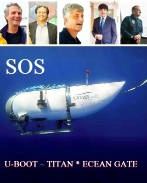
14.04.1912
Nordatlantik
-
18.06.2023
Nordatlantik
von CNN Wilipedia am 23.06.2023 - 17:33 Uhr | melden
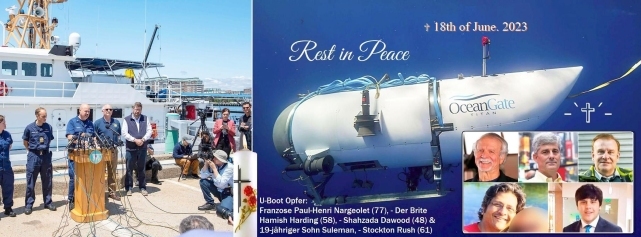
An Bord der „Titan“ war Paul-Henri Nargeolet (77) * Hamish Harding (58) * Shahzada Dawood (48) * Suleman Dawood (19) * Stockton Rush (61).
12 hours of oxygen left for missing Titan as mysterious sounds offer hope
A Canadian aircraft detected intermittent banging sounds emanating from vicinity of Titans last known location in Atlantic Ocean
12 hours of oxygen left for missing Titan as mysterious sounds offer hope. Twitter
It is a race against time. International rescue teams have mobilised to locate and save the passengers aboard the missing Titan submersible. With only 12 hours of oxygen remaining, the fate of the five individuals hangs precariously in the balance.
The United States Coast Guard, alongside Canadian counterparts, has been leading the multinational search operation. A Canadian aircraft detected intermittent "banging" sounds emanating from the vicinity of the submersibles last known location in the Atlantic Ocean. Despite the hopeful signs, authorities remain uncertain about the source of these mysterious noises.
"We dont know what they are, to be frank with you. We have to remain optimistic and hopeful," stated US Coast Guard Captain Jamie Frederick.
Among those aboard the Titan are Stockton Rush, CEO and founder of OceanGate Expeditions, British billionaire explorer Hamish Harding, renowned French diver Paul-Henri Nargeolet, and Pakistani businessman Shahzada Dawood, accompanied by his 19-year-old son, Suleman Dawood. The Dawood familys focus and hopes are solely on the safe return of their loved ones.
The submersible, equipped with a four-day emergency oxygen supply, submerged from its support vessel on Sunday morning for an expedition to the depths of the Titanic wreckage. Roughly an hour and 45 minutes later, contact with the surface ship, the Polar Prince, was lost.
Rescue efforts have intensified as additional assets and experts join the mission. The search has concentrated in the North Atlantic, near the location where sonar devices detected underwater noises. These sounds provide a glimmer of hope that the passengers may still be alive, although their origin remains unknown.
"We have to make a tough decision. Were not there yet," stressed Captain Frederick, emphasising the ongoing commitment to a search-and-rescue operation.
The international response has seen the deployment of US and Canadian military planes, coast guard vessels, remotely operated vehicles, and advanced sonar technology. Despite the collective efforts, locating and recovering the crew alive from the depths of the ocean presents an increasingly formidable challenge.
With each passing moment, the countdown to exhaustion of the submersibles emergency oxygen supply draws closer. Rescuers estimate that by Thursday morning, the passengers may face a critical oxygen shortage.
While hopes remain high, the situation grows more urgent, and time becomes the most critical factor. Every effort is being made to bring the missing Titan submersible back to the surface and ensure the safe return of the individuals on board. The global community waits with bated breath for news of a successful rescue operation that will end this gripping maritime crisis.
Editor’s Note: Read more here for CNN’s explainer on the catastrophic implosion that killed all five passengers on the missing submersible.
CNN —
Time is running out to find five people aboard a submersible missing since Sunday on what was supposed to be a roughly 10-hour round trip to see the wreck of the Titanic.
Oxygen levels inside the Titan submersible had been expected to last 96 hours, but after days of scanning above and below the surface of the North Atlantic Ocean, rescuers have found no trace of the vessel.
Banging noises heard Tuesday gave authorities “continued hope of survivors,” but by Wednesday, authorities hadn’t been able to locate the source of the sounds, or what had made them.
Here’s what we know so far.
How did they go missing?
The submersible was part of an eight-day journey conducted by OceanGate Expeditions, priced at $250,000 a person. The trip is based out of Newfoundland, with participants first traveling 400 nautical miles to the wreck site, which is about 900 miles (1,450 kilometers) off the coast of Cape Cod, Massachusetts.
The submersible began its two-hour descent to the wreck on Sunday morning, June 18. It lost contact with the Polar Prince, the support ship that transported the vessel to the site, 1 hour and 45 minutes into its descent, officials said.
Search operations began later that day.
It’s still not clear what happened to the submersible, why it lost contact, and how close to the Titanic it was when it went missing. After a dayslong, massive search for a Titanic-bound submersible that captured international attention, US authorities announced the vessel had suffered a “catastrophic implosion” – and new information from a US Navy source helps shed light on when that disaster may have unfolded.
All five people aboard the submersible, known as the “Titan,” were killed, the US Coast Guard said in a Thursday news conference. The tail cone and other debris from the missing submersible were found by a remotely operated vehicle about 1,600 feet from the bow of the Titanic, which rests about 13,000 feet deep in the North Atlantic Ocean.
“The debris is consistent with a catastrophic implosion of the vessel,” US Coast Guard Rear Adm. John Mauger, the First Coast Guard District commander, told reporters.
A senior Navy official told CNN the Navy detected an acoustic signature consistent with an implosion on Sunday in the general area where the vessel was diving and lost communication with its mother ship.
The Navy immediately relayed that information to on-scene commanders leading the search effort, and it was used to narrow down the area of the search, the official said Thursday.
But the sound of the implosion was determined to be “not definitive,” the official said, and the multinational efforts to find the submersible continued as a search and rescue effort. The Wall Street Journal was first to report about the acoustic signature picked up by the Navy.
Follow live Titanic submersible updates
Billionaire explorer and a prominent Pakistani father and son duo are on board the missing sub
Minutes before the US Coast Guard news conference, OceanGate Expeditions, the company that operated the deep-sea submersible, issued a statement grieving the five men on board.
“We now believe that our CEO Stockton Rush, Shahzada Dawood and his son Suleman Dawood, Hamish Harding, and Paul-Henri Nargeolet, have sadly been lost,” OceanGate said in a statement.
“These men were true explorers who shared a distinct spirit of adventure, and a deep passion for exploring and protecting the world’s oceans. Our hearts are with these five souls and every member of their families during this tragic time. We grieve the loss of life and joy they brought to everyone they knew.”
The news ends a saga that began Sunday when the Titan began its descent to explore the wreckage of the Titanic. The expedition was billed as “a chance to step outside of everyday life and discover something truly extraordinary” and cost each participant $250,000, an archived version of OceanGate’s website shows.
However, the cramped vessel lost contact with its mother ship about 1 hour and 45 minutes into its dive and did not surface as expected, prompting an extensive search and rescue operation in a remote area several hundred miles southeast of Newfoundland.
The expedition reflects the ongoing fascination with the Titanic more than a century after it hit an iceberg and sank on its maiden voyage, killing more than 1,500 people. The journey was also part of the growing business of wealthy adventure tourism, along with the space flights of Blue Origin or the rise of guided tours to Mount Everest.
The focus on the vessel renewed criticisms of OceanGate’s approach to safety from employees and other industry leaders. The 23,000-pound deep-sea vessel was made of an experimental combination of carbon fiber and titanium and relied on decidedly low-tech parts, such as a video game controller.
Officials will now be tasked with answering more questions, including piecing together what exactly happened and how to best prevent it from happening again.
Mit einem Geschenk hinterlassen Sie Ihr persönliches Zeichen in Gedenken an U-BOOT TITAN OCEAN GATE. Veredeln Sie jetzt für 2,99 Euro diese Gedenkseite durch ein Geschenk in Ihrem Namen.
 © Copyright 2022 Gedenkseiten.de
AGB | Impressum | Datenschutz | Presse | FAQ
Magazin | Eve-Trauerbegleitung | Meinungen | Gedenkseiten | Trauersprüche | Bewerten


